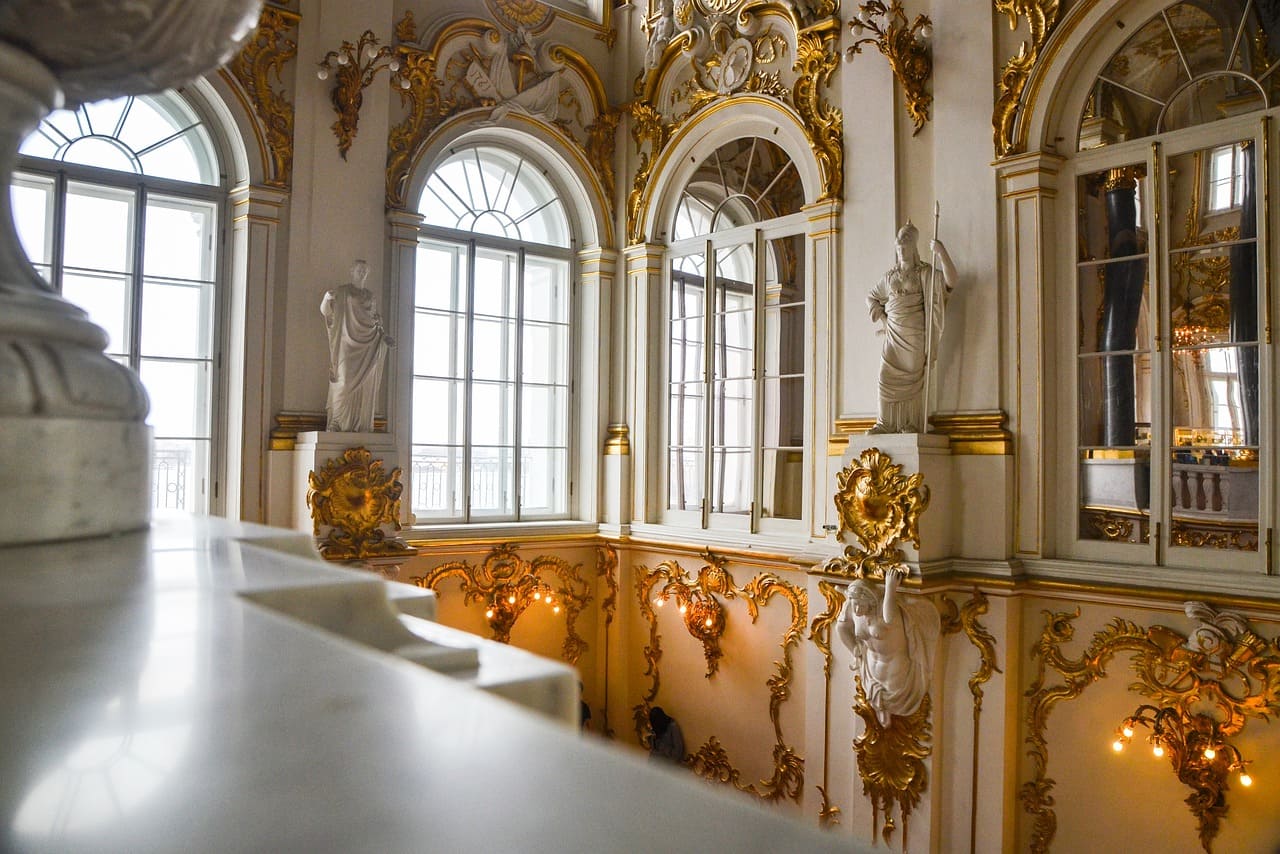
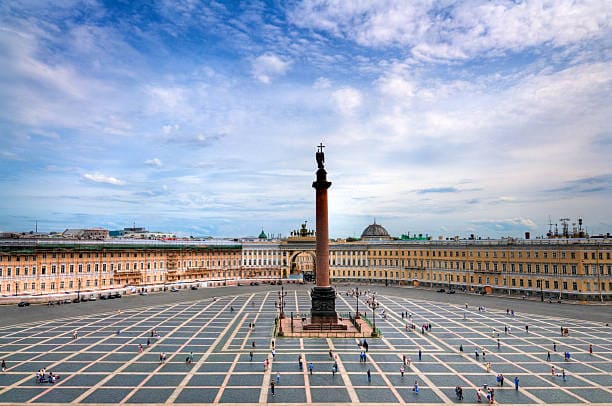
One of the most famous art museums in the world, this museum is housed in the Winter Palace,
and contains over 2.7 million exhibits including some of the world's greatest works of art.
The State Hermitage Museum is a museum of art and culture in Saint Petersburg, Russia.
It was founded in 1764 when Empress Catherine the Great acquired a collection of paintings from
the Berlin merchant Johann Ernst Gotzkowsky. The museum celebrates the anniversary of its founding
each year on 7 December, Saint Catherine's Day.It has been open to the public since 1852.
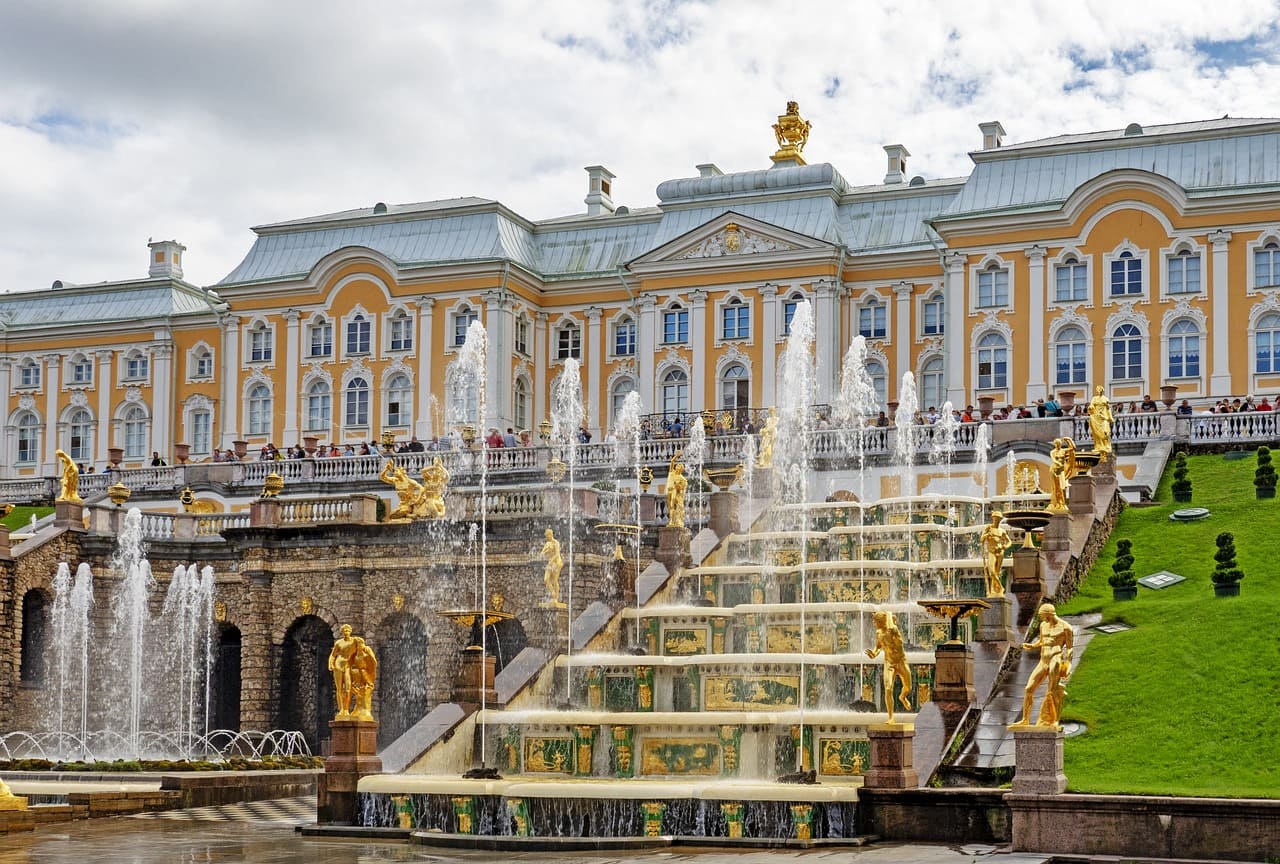
Peterhof is famous for its fountains, and the central water feature is the Grand Cascade.
The ensemble comprises several layers of terraces, two grottos, and statues depicting Biblical characters,
The Peterhof Palace is a series of palaces and gardens located in Petergof, Saint Petersburg, Russia,
commissioned by Peter the Great as a direct response to the Palace of Versailles by Louis XIV of France.
Originally intending it in 1709 for country habitation, Peter the Great sought to expand the property
as a result of his visit to the French royal court in 1717, inspiring the nickname of "The Russian Versailles".
The architect between 1714 and 1728 was Domenico Trezzini, and the style he employed became the foundation
for the Petrine Baroque style favored throughout Saint Petersburg.
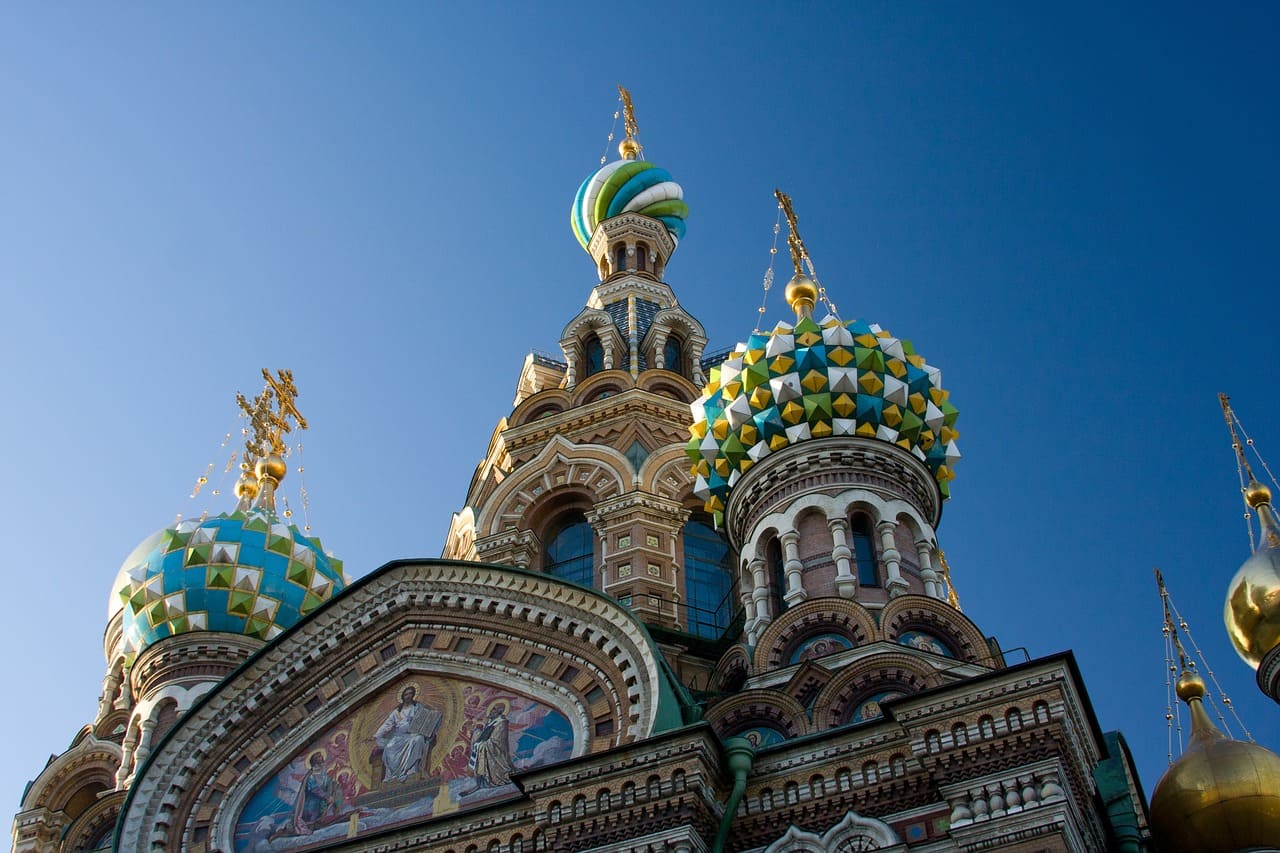
The Church of the Savior on Spilled Blood is a Russian Orthodox church in Saint Petersburg, Russia
which currently functions as a secular museum and church at the same time. The structure was constructed
between 1883 and 1907. It is one of Saint Petersburg's major attractions.
The church was erected on the site where political nihilists assassinated Emperor Alexander II in March 1881.
The church was funded by the Romanov imperial family in honor of Alexander II, and the suffix "on [Spilled] Blood"
refers to his assassination. Architecturally, the cathedral differs from Saint Petersburg's other structures.
The city's architecture is predominantly Baroque and Neoclassical, but the Savior on Blood harks back to medieval
Russian architecture in the spirit of romantic nationalism.
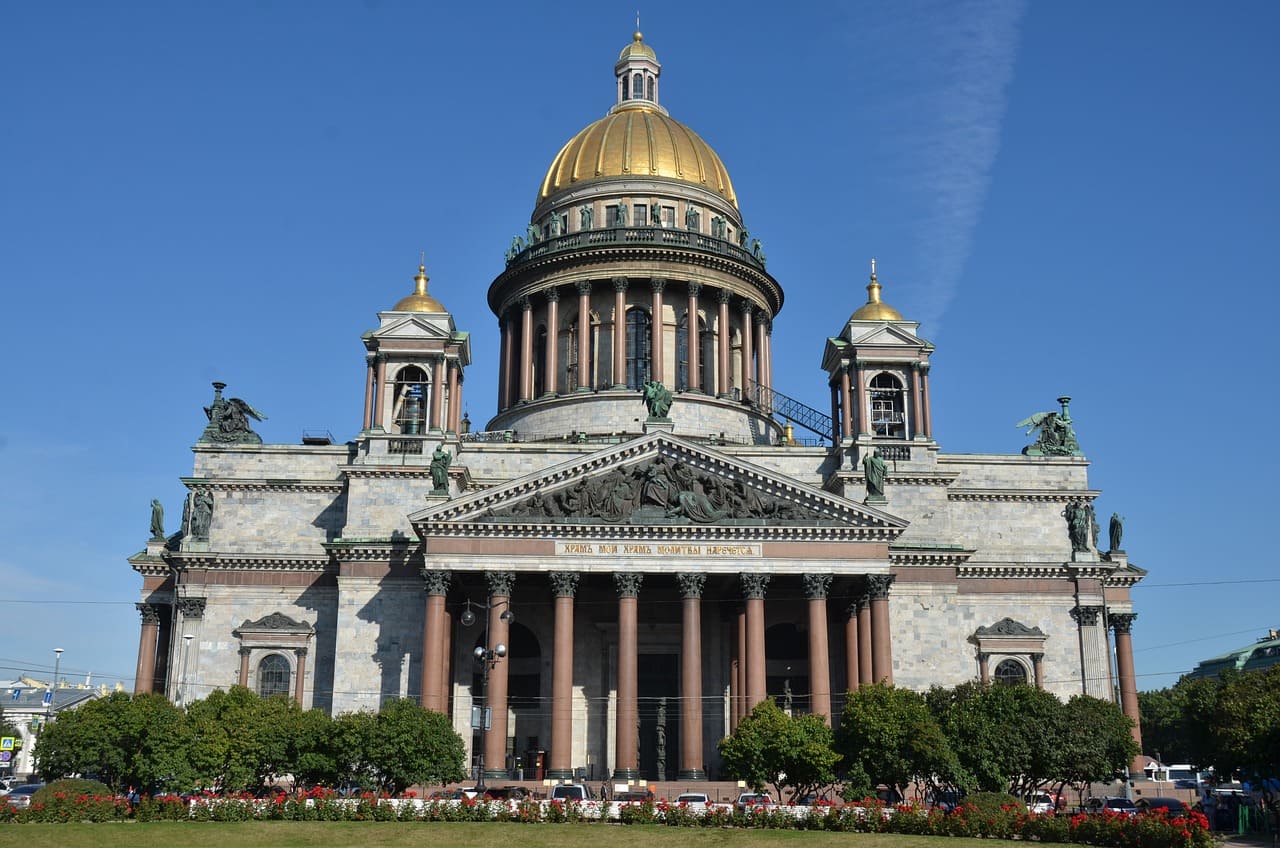
Saint Isaac's Cathedral or Isaakievskiy Sobor is a large architectural landmark cathedral that currently functions
as a museum with occasional church services in Saint Petersburg, Russia. It is dedicated to Saint Isaac of Dalmatia,
a patron saint of Peter the Great, who had been born on the feast day of that saint. It was originally built as a
cathedral but was turned into a museum by the Soviet government in 1931 and has remained a museum ever since, with
church services held in a side chapel since the 1990s. In 2017, the Governor of Saint Petersburg offered to transfer
the cathedral back to the Russian Orthodox Church, but this was not accomplished due to the protests of St Petersburg
citizens opposing the offer.
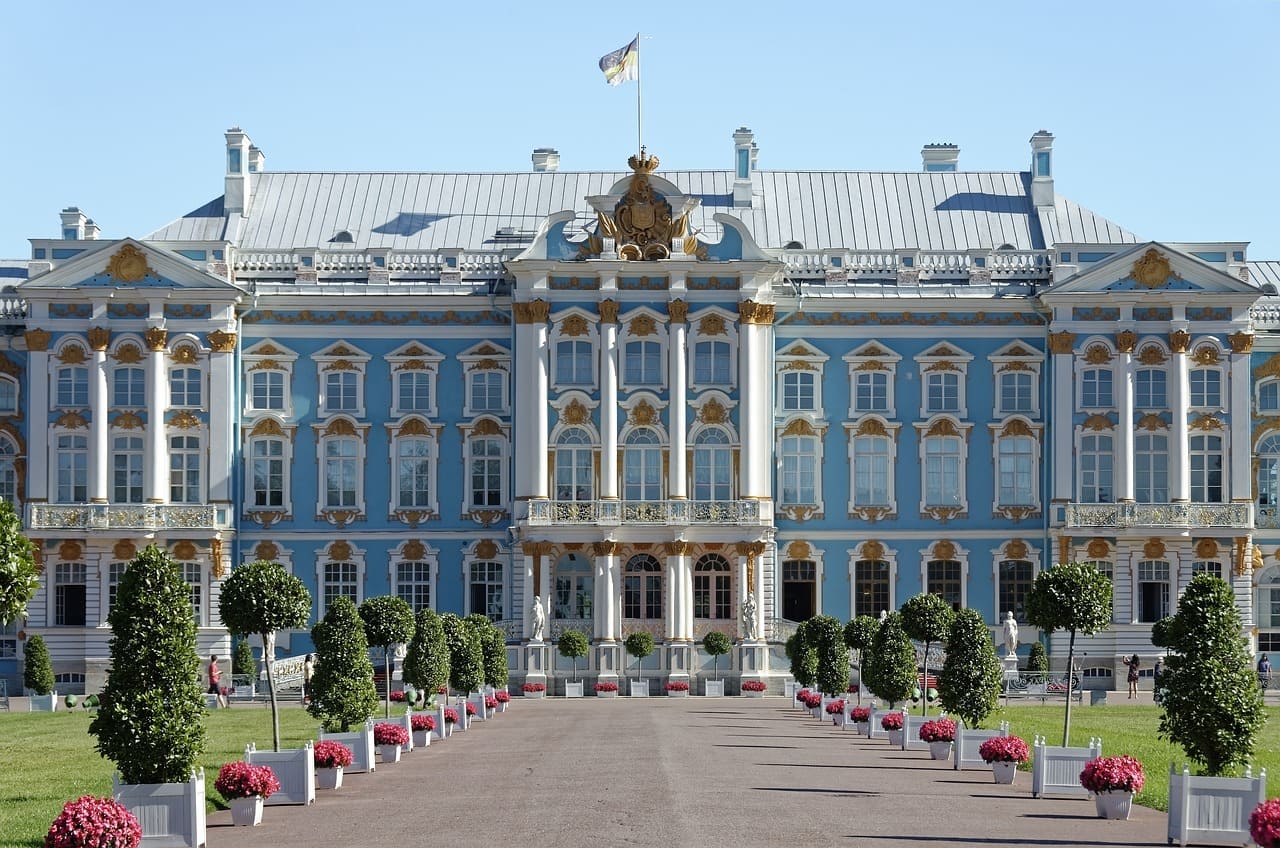
The Catherine Palace is named after Catherine I, the wife of Peter the Great, who ruled Russia for two years
after her husband's death. Originally a modest two-storey building commissioned by Peter for Catherine in 1717,
the Catherine Palace owes its awesome grandeur to their daughter, Empress Elizabeth, who chose Tsarskoe Selo as
her chief summer residence. Starting in 1743, the building was reconstructed by four different architects, before
Bartholomeo Rastrelli, Chief Architect of the Imperial Court, was instructed to completely redesign the building
on a scale to rival Versailles.